At Biocon Biologics, advanced analytical and bioanalytical sciences play a critical role in developing high-quality biosimilars — from recombinant insulins to monoclonal antibodies and other protein therapeutics.
Given the complexity of biologics, we use cutting-edge techniques to rigorously characterize the structural, chemical, and functional attributes of our biosimilars. This ensures they meet global regulatory standards and demonstrate comparability in safety, efficacy, and clinical outcomes.
Our expert teams and state-of-the-art platforms enable deep analytical insights across development, approval, and lifecycle management — ensuring consistency, quality, and patient trust at every stage.
Establishing Biosimilarity
Our R&D strength in biosimilar and biologics development is focused on a strategic QbD driven approach orthogonal techniques and fingerprint similarity.
Functional & Physicochemical Characterization
A multitude of assays, across a spectrum of molecules, is used to assess product structures and undertake functional characterization. Orthogonal technologies and suitable analytical methods are applied to in-process and batch-release tests. We also use sensitive methods to assess pharmacokinetics and immunogenicity to ensure global standards of safety and efficacy.
Cell-based Assays
Potency Assays for insulins, peptides, MAb and MAb conjugates
Immunology-based functional assays including T cell proliferation assays
Tumor cell-immune cell-culture assays
Cell-based Assays
Development and validation using surface plasmon resonance, radioligand binding and flow cytometry
Proliferation and cytokine evaluation assays
Cell-based Assays
Development, qualification and valuation of PK and immunogenicity measures, using ELISA and ECL formats.
Cell-based potency assays for neutralizing antibody determination
Functional & Physicochemical Characterization
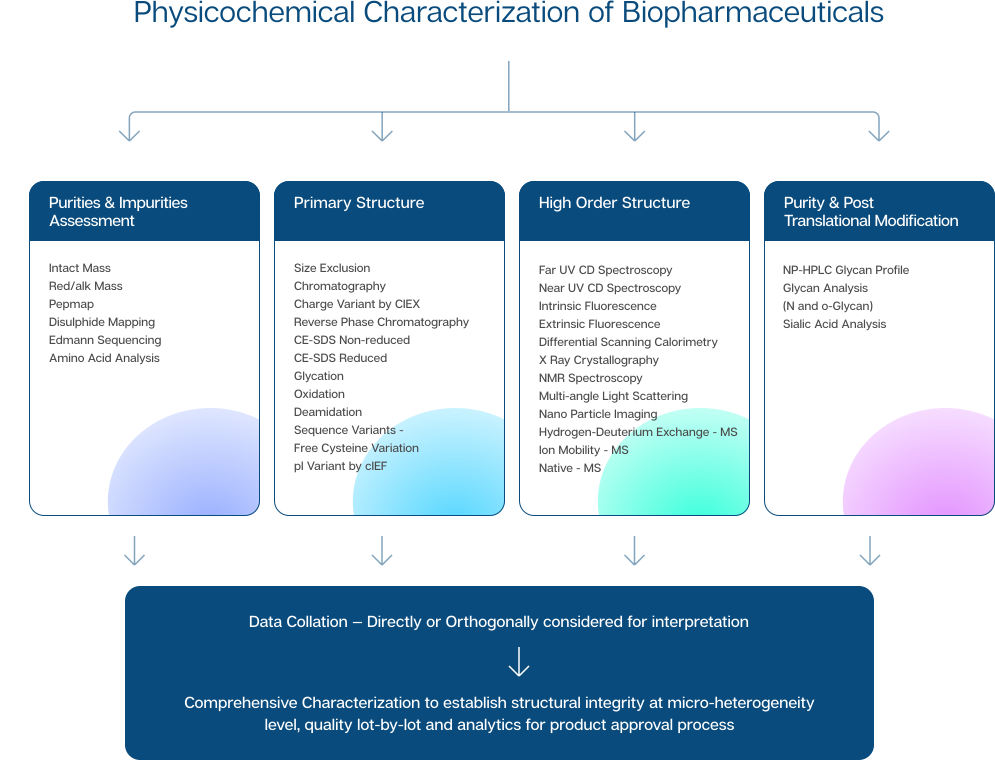
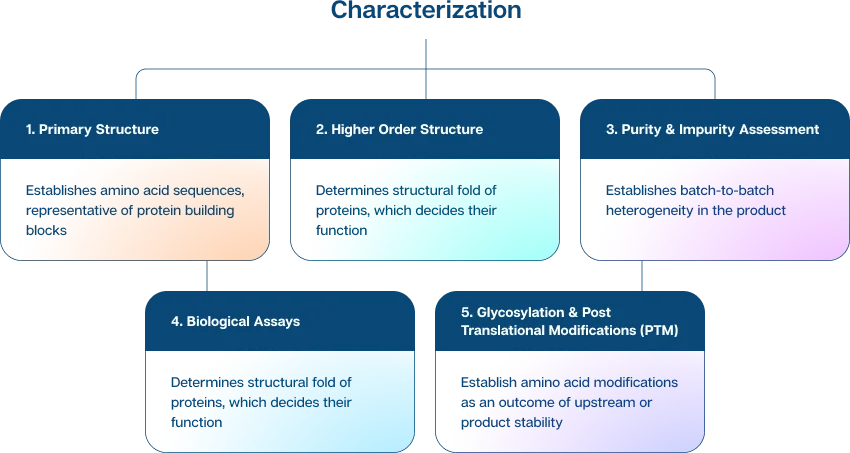
Analytical technologies are important to gain insights into the biological products’ structure, composition and properties.
Physicochemical characterization, for structural and compositional attributes
Functional characterization, for the product’s effectiveness (how the biological product binds to the target, and its biological outcome)
Attributes are measured using 40+ physicochemical and functional assays in our state-of-the-art analytical laboratories. Data generated through these complimentary analytical tools at various stages in the development cycle allows for deep and thorough understanding of our products. This in turn enables devising appropriate chemistry, manufacturing and control strategies to ensure consistency in the quality of the products manufactured at large scales. This comprehensive amalgamation of process and analytics is essential for product approvals.
This division plays a critical role in supporting the successful development and global commercialization of biosimilars. The team’s active participation...
You are now leaving the Biocon Biologics Corporate website for a Biocon Biologics EU Corporate microsite that is solely responsible for its content, including its compliance with guidelines applicable in certain geographies. Links to Biocon Biologics affiliate sites are provided as a resource to our visitors and may not be governed by the same regulatory requirements applicable to this site and unaffiliated third party sites are subject to their own terms and data protection notices and practices. Moreover, if their third party site is subject to other country laws, regulatory requirements, data protection requirements or medical practices may differ between countries and the information provided therein may not be suitable for use in your country.
You are now leaving the Biocon Biologics Corporate website for a Biocon Biologics U.S. Corporate microsite that is solely responsible for its content, including its compliance with guidelines applicable in certain geographies. Links to Biocon Biologics affiliate sites are provided as a resource to our visitors and may not be governed by the same regulatory requirements applicable to this site and unaffiliated third party sites are subject to their own terms and data protection notices and practices. Moreover, if their third party site is subject to other country laws, regulatory requirements, data protection requirements or medical practices may differ between countries and the information provided therein may not be suitable for use in your country.
You are now leaving the Biocon Biologics page for a Biocon Biologics affiliate site or third party site that is solely responsible for its content, including its compliance with guidelines applicable in certain geographies. Links to Biocon Biologics affiliate sites and third party sites are provided as a resource to our visitors and may not be governed by the same regulatory requirements applicable to this site and unaffiliated third party sites are subject to their own terms and data protection notices and practices. Moreover, if their third party site is subject to other country laws, regulatory requirements, data protection requirements or medical practices may differ between countries and the information provided therein may not be suitable for use in your country.